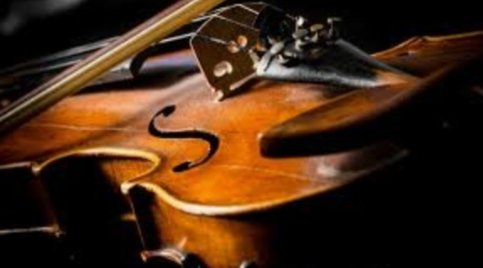
The violin, sometimes known as a fiddle, is a wooden string instrument in the violin family. Most violins have a hollow wooden body. It is the smallest and highest-pitched instrument in the family in regular use. Smaller violin-type instruments exist, including the violino piccolo and the pochette, but these are virtually unused. The violin typically has four strings, usually tuned in perfect fifths with notes G3, D4, A4, E5, and is most commonly played by drawing a bow across its strings. It can also be played by plucking the strings with the fingers (pizzicato) and, in specialized cases, by striking the strings with the wooden side of the bow (col legno).
The violin has been one of the most important of all instruments in classical music, for several reasons. The tone of the violin stands out above other instruments, making it appropriate for playing a melody line. In the hands of a good player, the violin is extremely agile, and can execute rapid and difficult sequences of notes.
Violins make up a large part of an orchestra, and are usually divided into two sections, known as the first and second violins. Composers often assign the melody to the first violins, typically a more difficult part using higher positions, while second violins play harmony, accompaniment patterns or the melody an octave lower than the first violins. A string quartet similarly has parts for first and second violins, as well as a viola part, and a bass instrument, such as the cello or, rarely, the double bass.

 Site Title